Undergraduate
Bachelor of Science (B.Sc.) in Mechanical Engineering
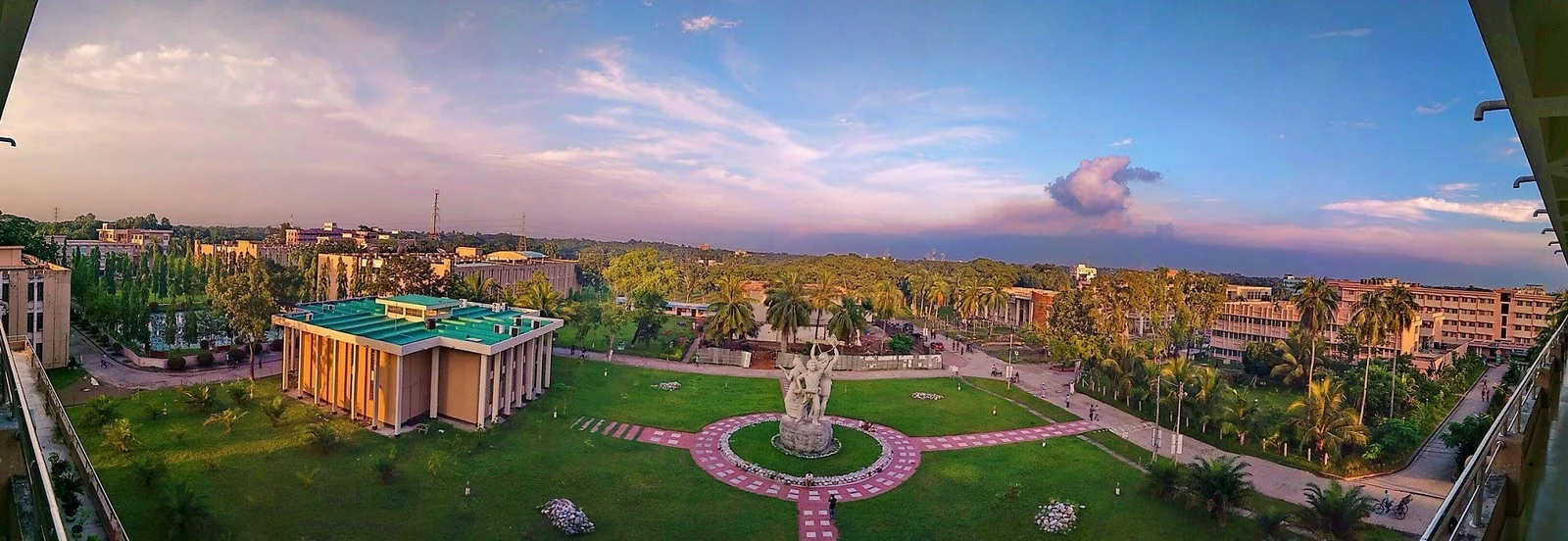
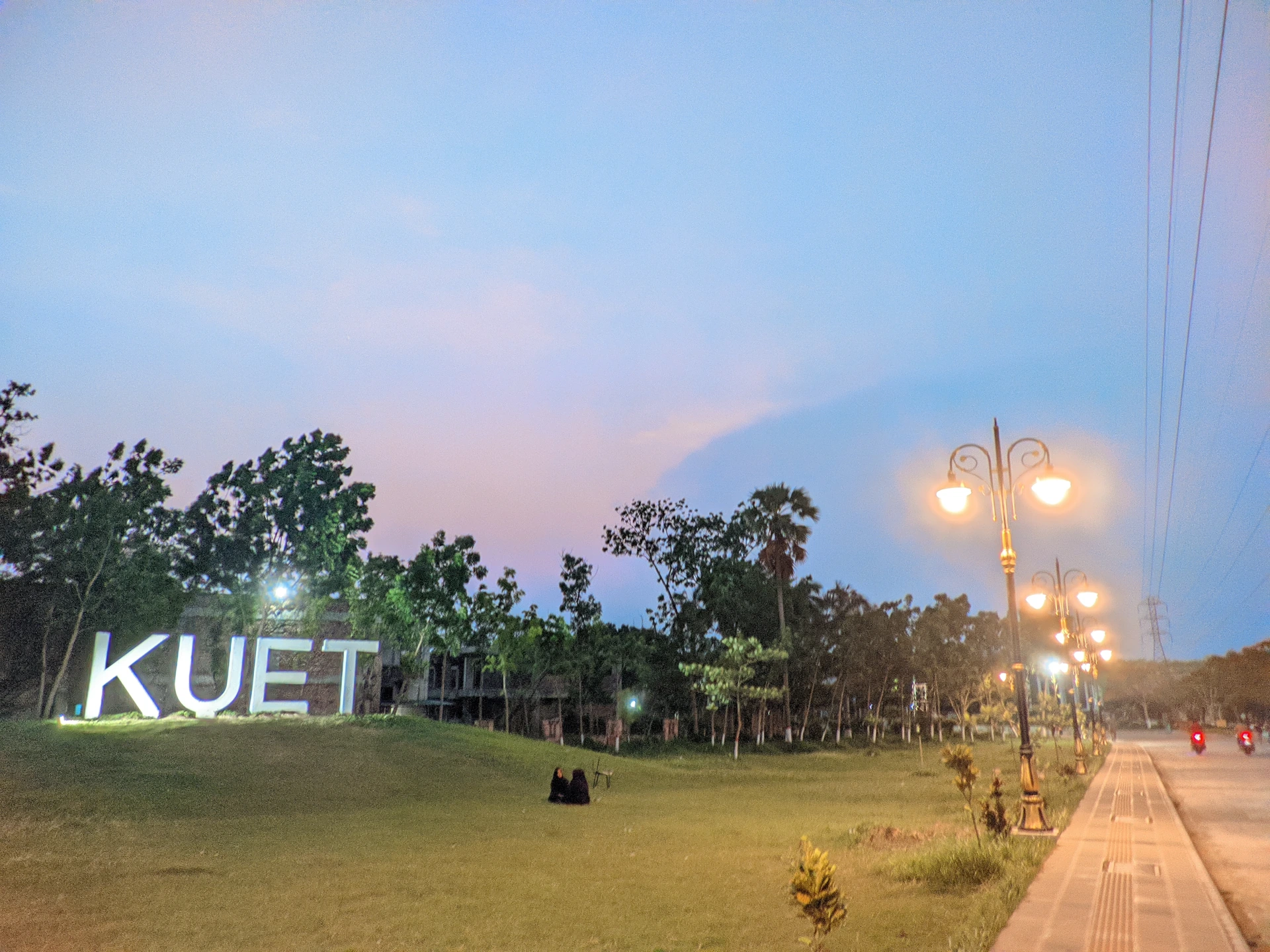
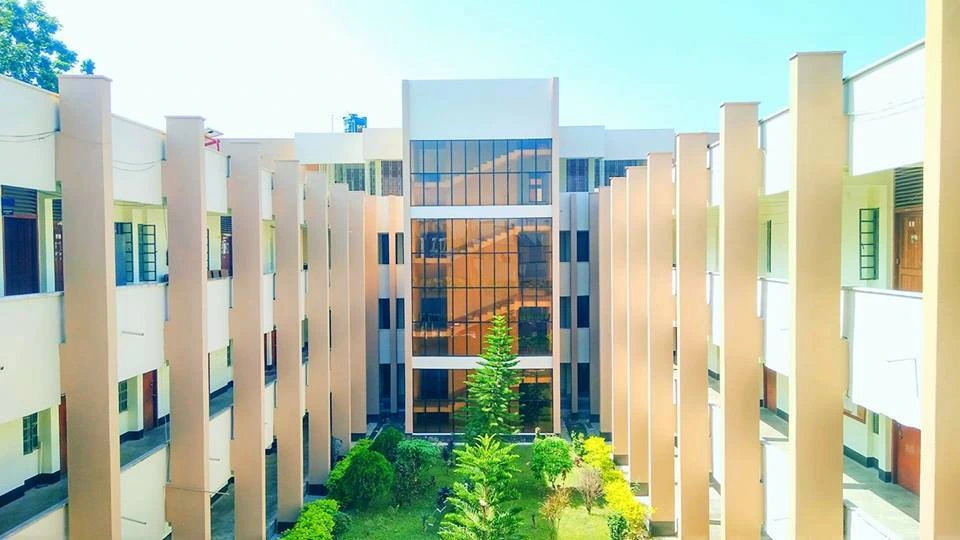
Khulna University of Engineering & Technology
Khulna, Bangladesh · March 2022 – August 2026
- Overall CGPA
- 3.42 / 4.00
- Final six semesters
- 3.54 / 4.00
- Class position
- 29 / 142
- Credits completed
- 160.00
Top 20%
Undergraduate Coursework
40 theory courses, alongside sessionals and project work.
Select a semester, then open a course to see the topics covered.
10 courses · 20.75 credits
No courses found. Try another course code, title or topic.
First Year · First Term
20.75 creditsCh 1105Engineering Chemistry3.00 credits
- Polymer chemistry. Polymerization, copolymerization, ionic polymerization, living polymers, and the structure and properties of macromolecules.
- Plastics and fibres. Classification, raw materials, manufacture, properties and uses of plastics and synthetic fibres.
- Rubber. Natural rubber and latex treatment; raw materials, reactions and properties of synthetic rubber.
- Industrial chemicals. Raw materials and manufacture of fertilizers, paper, sugar and cement.
- Colloids. Classification, preparation, properties, dialysis, electrodialysis, ultrafiltration, electrophoresis and electroosmosis; electrical double layers, zeta potential, micelles and applications.
- Corrosion. Chemical, electrochemical, galvanic, atmospheric and soil corrosion; influencing factors and prevention.
- Glass and ceramics. Raw materials, classification, manufacturing processes, properties and applications.
Ch 1106Engineering Chemistry — Sessional0.75 credits
- Volumetric analysis. Acid–base and oxidation–reduction titrations; determination of iron, copper and calcium.
- Gravimetric analysis. Determination of sulphate and iron.
Hum 1105English3.00 credits
- Language skills. Reading, writing and speaking; word formation, roots, prefixes, suffixes, phrases, idioms, synonyms and antonyms.
- Sentence structure. Simple, compound and complex sentences; identification and analysis of clauses.
- Composition. Paragraphs, free composition and précis writing.
- Professional writing. Formal and informal reports, commercial correspondence, memos, letters, applications and tenders.
- Academic writing. Term-paper and thesis-writing techniques.
Hum 1106English — Sessional0.75 credits
- Practical work based on English (Hum 1105).
Math 1105Mathematics I4.00 credits
- Differentiation. Continuity; explicit, implicit and parametric functions; successive differentiation and Leibniz’s theorem.
- Expansion theorems. Rolle’s and mean-value theorems; Taylor and Maclaurin expansions; Lagrange and Cauchy remainders.
- Multivariable calculus and limits. Partial derivatives, Euler’s theorem and indeterminate forms using L’Hôpital’s rule.
- Curve geometry. Tangents, normals, subtangents, subnormals and pedal equations in Cartesian and polar coordinates.
- Curve analysis. Maxima, minima, inflection points, asymptotes, curvature, radius and centre of curvature, and curve tracing.
- Integration. Substitution, integration by parts, standard integrals and reduction formulae; definite integrals and summation of series.
- Special integrals. Wallis’s formula, improper integrals, and beta and gamma functions.
- Geometric applications. Areas between curves, arc lengths, volumes and surfaces of revolution, including the shell method.
ME 1105Thermal Engineering3.00 credits
- Mechanical engineering and energy. Engineering fields, energy sources, the global energy situation and energy resources in Bangladesh.
- Pure substances. Phases, phase diagrams, critical and triple points, water and steam properties; p–V, T–s and h–s diagrams, steam tables and Mollier charts.
- Heat engines. Operating principles of petrol engines, diesel engines and gas turbines.
- Steam generation. Common and modern boilers, mountings and accessories, equivalent evaporation and boiler efficiency.
- Refrigeration and air conditioning. Vapour-compression and absorption systems, refrigerant properties, human comfort, and summer and winter air conditioning.
- Combustion. Complete and incomplete combustion, stoichiometric air–fuel ratios, heat of reaction and combustion chemistry.
ME 1106Thermal Engineering — Sessional0.75 credits
- Experiments based on Thermal Engineering (ME 1105).
ME 1107Manufacturing Process4.00 credits
- Casting. Pattern design, moulding sands and testing, core making, die and centrifugal casting, investment and continuous casting, and casting defects.
- Joining processes. Gas, arc, shielded-arc, resistance, pressure, thermit and energy-beam welding; welding defects, soldering, brazing, metal spraying and hard facing.
- Metal forming. Hot- and cold-working processes and their machines and tools.
- Metal cutting. Chip formation, chip types and breakers, cutting forces, cutting fluids, tool geometry, tool cost and tool life.
- Machine tools. Lathes and accessories, turret and special-purpose lathes, drilling, shaping, planing and milling.
- Threads and gears. Manufacturing processes for screw threads and gears and the associated machines.
- Finishing. Surface and centreless grinding, honing, lapping and superfinishing.
- Nontraditional processes. Electrochemical, electrical-discharge, ultrasonic, laser-beam and plasma-arc machining.
ME 1108Manufacturing Process — Sessional0.75 credits
- Machine-shop practice. Operations on lathes, drilling machines, milling machines, shapers and grinding machines.
- Experiments associated with Manufacturing Process (ME 1107).
MES 1102Workshop Practice0.75 credits
- Woodworking. Hand and machine tools, timber identification, sawing, planing and chiselling.
- Pattern making. Preparation of patterns for casting.
- Foundry practice. Foundry tools, moulding-sand preparation and metal casting.
- Welding practice. Welding tools and machines, arc welding and gas welding.
First Year · Second Term
20.75 creditsEE 1205Electrical Engineering & Electrical Machines4.00 credits
- Circuit fundamentals. Ohm’s law and Kirchhoff’s current and voltage laws.
- AC circuits. Steady-state R, RL and RLC circuits; RMS and average values and phasor algebra.
- Induction motors. Operating principles, torque–speed characteristics, starting torque, speed control and braking; single-phase motors.
- Synchronous machines. Operating principles, starting, synchronization and industrial applications.
- Vehicle electrical machines. Servomotors, self-starters and alternators; construction, operation and applications.
- DC machines. Shunt, series and compound generators and motors; starting, speed control and industrial motor selection.
- Transformers. Construction, operating principles and three-phase connections.
EE 1206Electrical Engineering & Electrical Machines — Sessional0.75 credits
- Experiments based on Electrical Engineering & Electrical Machines (EE 1205).
Hum 1205Economics and Accounting3.00 credits
- Economic principles. Definitions, basic principles, marginal analysis and optimization.
- Microeconomics. Demand, supply, elasticity, price determination, markets, production functions and productivity; internal and external economies and diseconomies.
- Macroeconomics. Savings, investment, national income and inflation; project appraisal using NPV, IRR and cost–benefit analysis.
- Economic policy. Monetary, fiscal and trade policy, development and planning with reference to Bangladesh.
- Accounting foundations. Users of accounting information, GAAP, the accounting equation, and the relationship between accounting and engineering.
- Recording and statements. Transactions, debit and credit, journals, ledgers, trial balances and adjustments; income, equity, balance-sheet and cash-flow statements.
- Cost accounting. Cost classification, cost statements, materials and labour costs, wages and salaries, and operating and service costing.
Math 1205Mathematics II3.00 credits
- Three-dimensional geometry. Coordinates, distances, section formulae, projections, direction cosines, planes, straight lines, spheres, cones and central conicoids.
- First-order differential equations. Formation, order and degree; first-order, first-degree solution methods and applications in geometry and physics.
- Higher-order linear equations. Constant-coefficient equations, general and short methods, variation of parameters and undetermined coefficients.
- Cauchy–Euler equations and applications of higher-order differential equations.
ME 1200Mechanical Engineering Drawing1.50 credits
- Projection. Orthogonal projection, visibility and angle problems; oblique, isometric and auxiliary views.
- View conversion. Orthographic and auxiliary views from pictorial views, and pictorial views from orthographic drawings.
- Development of objects and descriptive geometry, including projection-transfer methods and applications.
- Working drawings. Machine elements and sectional views.
ME 1209Engineering Mechanics I3.00 credits
- Force systems. Mechanical principles, concurrent forces, force components and three-dimensional resultants.
- Equilibrium. Particle equilibrium, free-body diagrams, parallel and nonconcurrent forces, and equilibrium in space.
- Force–couple systems. Transmissibility, moments, couples, equivalent systems and force-system reduction.
- Geometric properties. Centroids, centres of gravity, area and mass moments of inertia, radii of gyration, parallel-axis theorem and products of inertia.
- Structures. Analysis of trusses and frames.
- Friction. Sliding, wedges, square-threaded screws, journal and thrust friction, rolling friction and belt friction.
- Virtual work and energy. Mechanical efficiency, potential energy, equilibrium and stability.
ME 1210Engineering Mechanics I — Sessional0.75 credits
- Experiments based on Engineering Mechanics I (ME 1209).
Ph 1205Physics4.00 credits
- Relativity. Reference frames, the Michelson–Morley experiment, Galilean and Lorentz transformations, time dilation, length contraction, mass–energy relations and velocity transformations.
- Wave–particle duality. Photoelectric and Compton effects, quantum theory of light, de Broglie waves, and phase and group velocities.
- Atomic structure. Bohr’s model, hydrogen spectra and energy levels, correspondence principle, vector atom model, orbital and spin quantization, magnetic moments and electron shells.
- Lasers. Coherent radiation, temporal and spatial coherence, population inversion and stimulated emission; gas, ruby, YAG, Raman and semiconductor lasers and their applications.
- Crystalline solids. Crystal structure and classification; Einstein and Debye models of lattice heat capacity and their temperature limits.
- Electronic properties of solids. Electrical and thermal conductivity, momentum space, Fermi–Dirac statistics, free electrons, electron emission, Hall effect, mobility, drift velocity and band theory.
- Nuclear physics. Nuclear constituents and properties, binding energy, packing fraction, nuclear forces, fission and fusion.
- Radioactivity. Decay laws, half-life, mean life, successive disintegration and practical applications.
Ph 1206Physics — Sessional0.75 credits
- Laboratory experiments in optics, sound and the topics of Physics (Ph 1205).
Second Year · First Term
19.75 creditsEE 2105Electronics3.00 credits
- Electronic devices. Semiconductor junctions, rectifier, Schottky, Zener, tunnel and varactor diodes; LEDs, photodiodes and solar cells.
- Transistors and power devices. BJT, FET, MOS, unijunction transistor, SCR, DIAC, TRIAC and vacuum tubes.
- Amplifiers. Biasing and classification; BJT/FET, operational and differential amplifiers and their applications.
- Digital circuits. OR, AND, NOT, NAND, NOR and XOR gates; flip-flops, shift registers, counters, binary/BCD codes and comparators.
- Industrial electronics. Regulated power supplies, ignition, resistance welding and timing circuits.
- Instrumentation and applications. CRO, transducers, temperature measurement, audio electronics, integrated circuits and microprocessors.
EE 2106Electronics — Sessional0.75 credits
- Experiments based on Electronics (EE 2105).
Hum 2105Industrial Environment and Sociology3.00 credits
- Industry and environment. Population and economic growth, industrialization, urbanization, energy use and pollution.
- Environmental balances and waste. Steady and unsteady mass/energy balances; industrial and hazardous waste generation, prevention, collection, transport, treatment, monitoring and disposal.
- Environmental impact and regulation. National and international regulations and initiatives.
- Industrial law. Inspection, health, hygiene, safety, welfare, working hours, employment, leave, wages, penalties and implementation.
- Bangladesh and international frameworks. Labour Act, EPZ industrial-relations provisions, environmental conservation legislation and the International Labour Organization.
- Sociology. Society, communities, associations and groups; social history and culture of Bangladesh.
- Social change. Urban ecology, industrialization, population, poverty, crime and other social problems.
Math 2105Mathematics III3.00 credits
- Vector calculus. Differentiation and integration of vectors; gradient, divergence and curl and their physical interpretations.
- Integral theorems. Line, surface and volume integrals; Green’s, Gauss’s and Stokes’s theorems and applications; curvilinear coordinates.
- Matrices. Matrix types, elementary transformations, rank, inverse, linear dependence and independence, and consistency and solution of linear systems.
- Eigenvalues and eigenvectors.
- Complex variables. Complex functions, limits, continuity, analytic functions, their properties and singularities.
ME 2100Computer Aided Drawing1.50 credits
- Working drawings of machine elements using AutoCAD and SOLIDWORKS.
ME 2105Thermodynamics4.00 credits
- Thermodynamic foundations. Macroscopic and microscopic viewpoints, thermodynamic terms, heat, work and path dependence.
- Ideal gases. Suitability as thermodynamic fluids, process equations, specific heats, internal energy and enthalpy.
- Thermodynamic laws. Corollaries, reversibility, irreversibility, entropy, Gibbs and Helmholtz functions and Maxwell relations.
- Air-standard cycles. Carnot, Otto, Diesel, dual, Stirling, Ericsson, Joule and Brayton cycles; p–V and T–s diagrams, efficiency, compressors and blowers.
- Vapour-power cycles. Carnot, Rankine, reheat, regeneration, binary and combined cycles.
- Gas and vapour mixtures. Gravimetric/volumetric analysis, Dalton’s law, mixture volume and entropy, and isentropic mixture processes.
- Psychrometry. Specific and relative humidity, dew point, dry/wet-bulb temperatures, adiabatic saturation and psychrometric charts.
- Fuels. Classification, coal and petroleum formation, coal grading, calorific-value measurement, fuel properties, fuel development and nuclear fuels.
ME 2106Thermodynamics — Sessional0.75 credits
- Experiments based on Thermodynamics (ME 2105).
ME 2113Fluid Mechanics I3.00 credits
- Fluid properties. Continuum concepts, fluid classification, viscosity measurement, fluid stress/strain, compressibility, elasticity, surface tension, capillarity and vapour pressure.
- Fluid statics. Pressure gradients, manometers, forces on submerged surfaces, buoyancy, flotation, metacentric height and stability.
- Accelerating fluids. Containers undergoing constant acceleration or rotation.
- Flow kinematics and dynamics. Particle velocity/acceleration, flow types, system and control-volume descriptions, and integral/differential continuity.
- Flow-energy relations. Euler and Bernoulli equations, the energy equation, energy-grade and hydraulic-grade lines.
- Dimensional analysis. Units, dimensional homogeneity, Buckingham’s pi theorem and similitude.
- Flow measurement. Pitot tubes, anemometers, Venturi meters, weirs, notches, orifices and mouthpieces; tank emptying and flow between vessels.
ME 2114Fluid Mechanics I — Sessional0.75 credits
- Experiments based on Fluid Mechanics I (ME 2113).
Second Year · Second Term
19.75 creditsMath 2205Mathematics IV4.00 credits
- Fourier series. Existence, different periods and half-range expansions.
- Special functions. Bessel functions and Legendre polynomials; orthogonality, generating functions and recurrence relations.
- Partial differential equations. Formation, classification, and one-dimensional heat and wave equations.
- Laplace’s equation. Solutions in two-dimensional Cartesian and polar coordinates and in spherical and cylindrical coordinates; heat-distribution applications.
- Laplace transforms. Existence, elementary transforms, properties, inverse transforms and convolution.
- Transform methods. Solutions of ordinary and partial differential equations using Laplace transforms.
ME 2209Engineering Mechanics II3.00 credits
- Particle kinematics. Rectilinear/curvilinear motion, relative motion, and Cartesian, tangential/normal and radial/transverse components.
- Rigid-body kinematics. Translation, fixed-axis rotation, general plane motion, fixed-point and general motion; relative velocity/acceleration and Coriolis acceleration.
- Particle kinetics. Newton’s second law, linear/angular momentum and central-force motion.
- Space mechanics. Two-body and satellite motion, orbit equations, orbiting/escape conditions, orbital periods and orbit changes.
- Work, energy and impact. Power, efficiency, potential energy, conservative forces, energy conservation, impulse–momentum, and direct/oblique central impact.
- Planar rigid-body kinetics. D’Alembert’s principle, constrained motion, work–energy and impulse–momentum methods, and impact.
- Three-dimensional dynamics. Angular momentum, kinetic energy, Euler’s equations and Euler angles.
- Gyroscopic motion. Steady precession, axisymmetric bodies, gyroscopic couples, aircraft/ship effects and stabilization.
ME 2210Engineering Mechanics II — Sessional0.75 credits
- Experiments based on Engineering Mechanics II (ME 2209).
ME 2211Mechanics of Solids3.00 credits
- Stress and strain. Internal forces, tensile/compressive/bearing/shear stress, thin-walled pressure cylinders and stress–strain diagrams.
- Deformation. Axial, biaxial and triaxial deformation; statically indeterminate members and thermal stresses.
- Determinate beams. Loads and supports, shear-force/bending-moment diagrams, flexural and shear stresses, and economic sections.
- Beam deflection and reinforced beams. Double integration, area-moment and superposition methods; reinforced concrete beam design.
- Indeterminate beams. Propped, restrained and continuous beams, three-moment equations and support reactions.
- Torsion. Torsion formula, twist, shaft couplings, helical springs and circular-shaft design.
- Combined loading. Axial/bending stresses, kern of a section, stress at a point, oblique sections, Mohr’s circle, strain transformation and strain rosettes.
- Columns and connections. Slenderness, Euler, empirical and secant formulae; riveted joints and eccentrically loaded riveted/welded connections.
ME 2212Mechanics of Solids — Sessional0.75 credits
- Experiments based on Mechanics of Solid (ME 2211).
ME 2213Fluid Mechanics II3.00 credits
- Momentum and jets. Momentum equation, impact on stationary/translating flat and curved vanes, duct-flow applications and correction factors.
- Viscous pipe flow. Darcy–Weisbach equation, pressure gradients and shear stress, Hagen–Poiseuille flow, inclined/annular pipes, parallel plates and Moody charts.
- External and turbulent flow. Submerged bodies, Prandtl’s law and surface-roughness effects.
- Boundary layers. Thickness, growth, governing relations and von Kármán’s integral equation; flat-plate flow with pressure gradients.
- Boundary-layer behaviour. Separation and control, skin-friction drag, displacement/momentum thickness, transition and roughness.
- Compressible flow. One-dimensional continuity, momentum and energy equations, Mach cones and stagnation properties.
- Compressible-flow applications. Isentropic nozzles, adiabatic/nonadiabatic pipe flow, friction, shock waves, Fanno lines and Rayleigh lines.
ME 2214Fluid Mechanics II — Sessional0.75 credits
- Experiments based on Fluid Mechanics II (ME 2213).
ME 2221Computer Programming3.00 credits
- C fundamentals. Program output, data types, variables, operators, arithmetic limits and formatted input/output.
- Program development. Debugging, testing and control flow with if/else, switch, goto, while, do–while and for loops.
- Arrays and strings. One- and multidimensional arrays, matrix operations, sorting, vowel/consonant processing, palindrome detection, word counting/reversal and string-library functions.
- Functions. Passing arguments by value and reference; static and global variables.
- Recursion. Greatest common divisor, Fibonacci numbers, factorials and the Tower of Hanoi.
- Pointers. Dynamic memory allocation, arrays of pointers and passing pointers to functions.
- Structures and unions. Structured data processing and linked lists.
- File handling. Opening, closing, creating and processing data files; an introduction to low-level programming.
ME 2222Computer Programming — Sessional1.50 credits
- Programming practice in C, applying the topics of Computer Programming (ME 2221).
Third Year · First Term
19.75 creditsME 3100Special Studies0.75 credits
- Presentations on selected topics.
ME 3105Heat Transfer I3.00 credits
- Heat-transfer fundamentals. Conduction, convection and radiation; thermal properties of materials.
- Conduction equations. One-, two- and three-dimensional heat flow; steady solutions with and without heat generation and variable conductivity.
- Conduction applications. Composite walls, uniform-section fins, critical insulation thickness and boundary conditions.
- Transient conduction. Analytical and numerical solutions, relaxation methods, negligible internal resistance and Heisler charts.
- Radiation fundamentals. Electromagnetic spectrum, Planck’s law, Wien’s law, Stefan–Boltzmann relation, black/grey bodies, spectral properties and Kirchhoff’s law.
- Radiative exchange. Shape factors, reradiating surfaces, radiation shields and network methods.
- Solar and atmospheric radiation. Emission, absorption, measurement and equilibrium temperature.
ME 3106Heat Transfer I — Sessional0.75 credits
- Experiments based on Heat transfer I (ME 3105).
ME 3109Engineering Mechanics III3.00 credits
- Machinery dynamics. Inertia and kinetic energy of rotating/reciprocating parts, turning-moment diagrams, energy/speed fluctuation and flywheels.
- Balancing. Stationary, rotating and reciprocating masses; in-line and V engines, direct/reverse cranks and balancing machines.
- Mechanisms. Gearing laws and tooth forms, gear types and trains, governors and control, cams, followers and cam profiles.
- Single-degree-of-freedom vibration. Free, forced and damped vibration, beats, resonance and transient response.
- Shaft and pendulum vibration. Torsional oscillation, whirling, transverse shaft vibration and energy methods.
- Multiple-degree systems. Two-degree elastic systems, multirotor shaft torsion and self-excited vibration.
- Vibration control. Measurement instruments, machinery isolation, elastic suspension and vibration absorbers.
ME 3110Engineering Mechanics III — Sessional0.75 credits
- Experiments based on Engineering Mechanics -III (ME 3109).
ME 3117Machine Design I3.00 credits
- Design approach. Stress analysis, tolerances and allowances.
- Variable loading. Stress concentrations and design under fluctuating loads.
- Fasteners and joints. Screw fastenings and riveted joints.
- Springs and columns. Spring design and columns under central and eccentric loading.
- Power-transmission elements. Combined stresses, shafts, keys and couplings.
ME 3118Machine Design I — Sessional0.75 credits
- Solution of design problems based on Machine Design I (ME 3117).
ME 3119Statistics & Quality Control4.00 credits
- Data description. Events, variables, populations and samples; grouped/ungrouped data and frequency distributions.
- Descriptive statistics. Mean, median, mode, standard deviation, moments, skewness, peakedness and coefficient of variation.
- Probability. Sets, Venn diagrams, probability axioms/rules, conditional probability, independence and Bayes’s formula.
- Distributions. Probability densities; hypergeometric, geometric, binomial, Poisson, normal, uniform, exponential, chi-squared and t distributions.
- Statistical inference. Hypothesis tests, error types, one-/two-sided tests, operating-characteristic curves and goodness of fit.
- Process-control foundations. Quality costs, chance/assignable causes, Pareto analysis, cause-and-effect diagrams and histograms.
- Control-chart design. Limits, sample size/frequency, rational subgroups, chart-pattern interpretation, operating characteristics and average run length.
- Attribute and variable charts. Nonconforming fractions, defect counts, constant/variable sample sizes, demerit systems, X-bar, range and standard-deviation charts, and non-normality.
- Process capability. Analysis using histograms and control charts.
- Acceptance sampling. Random, single, double, multiple and sequential sampling plans and military-standard sampling.
- Quality systems. Total quality management, quality-control circles, total quality control and ISO series.
ME 3121Numerical Computation for Mechanical Engineers3.00 credits
- Interpolation. Newton forward/backward, Lagrange, Stirling and Bessel methods.
- Nonlinear equations. Iteration, regula falsi and Newton–Raphson methods; graphical interpretation, initial guesses and convergence tests.
- Linear systems. Iterative methods including Gauss–Seidel, matrix inversion and Gauss–Jordan methods, Gaussian elimination with pivoting and triangular factorization.
- Numerical differentiation. Taylor expansion, forward/central/backward differences, error estimation, graphical differentiation and partial derivatives.
- Numerical integration. Equidistant-ordinate formulae, trapezoidal, Simpson and Weddle rules, graphical integration and error analysis.
- Ordinary differential equations. Euler, Taylor-series, Runge–Kutta and predictor–corrector methods, applications and error analysis.
- Partial differential equations. Elliptic, parabolic and hyperbolic equations, finite differences, d’Alembert’s solution, Crank–Nicolson schemes, iteration, residuals and accuracy tests.
- Curve fitting. Linear regression, correlation, least squares, confidence limits and significance tests.
- Eigenvalue problems. Eigenvalues/eigenvectors, homogeneous linear systems and eigenvalue-size estimation.
ME 3122Numerical Computation for Mechanical Engineers — Sessional0.75 credits
- Computer-based solutions of problems from Numerical Computation for Mechanical Engineers (ME 3121).
Third Year · Second Term
20.75 creditsME 3200Mechanical Engineering Project0.75 credits
- Development of a mechanical element.
ME 3205Heat Transfer II3.00 credits
- Convection. Hydrodynamic and thermal boundary layers, control-volume analysis and laminar flat-plate heat transfer.
- Internal convection. Fully developed pipe flow, constant heat flux/wall temperature, dimensional analysis, turbulence correlations and hydraulic diameter.
- External convection. Free/forced convection over plates, cylinders, spheres, inclined pipes and tube bundles.
- Condensation. Dropwise/filmwise modes, film turbulence, Nusselt relations and condensation number.
- Phase-change heat transfer. Melting, solidification, bubble growth, pool/film boiling, boiling curves, critical heat flux and forced-convection boiling.
- Heat exchangers. Types, compact exchangers, LMTD, effectiveness–NTU methods, fouling and design.
- Mass transfer. Fick’s law, binary diffusion, transfer coefficients, evaporation and heat/mass-transfer analogy.
ME 3206Heat Transfer II — Sessional0.75 credits
- Experiments based on Heat Transfer II (ME 3205).
ME 3215Engineering Metallurgy4.00 credits
- Material properties and testing. Malleability, ductility, hardness, toughness and fatigue resistance; destructive and nondestructive testing.
- Structure and solidification. Crystal lattices, nucleation, grain growth and solidification variables.
- Phase diagrams. Binary-alloy equilibrium diagrams, structure–property relationships and the iron–iron carbide diagram.
- Heat treatment. Hardening, annealing, normalizing, quenching, tempering, case/edge hardening, nitriding and precipitation; TTT diagrams and S-curves.
- Ferrous metals. Pig, wrought and cast irons; microstructures and impurities; Bessemer/open-hearth steelmaking, carbon steels, alloy steels and stainless steels.
- Nonferrous metals and alloys. Production, properties and uses of copper, aluminium, nickel, tin and lead; noble-metal alloys, bearing and spring materials.
- Surface and joining metallurgy. Surface treatments, plating, coatings and metal spraying.
- Powder metallurgy. Powder characteristics, pressing, sintering and consolidation.
ME 3216Engineering Metallurgy — Sessional0.75 credits
- Experiments based on Engineering Metallurgy (ME 3215).
ME 3217Machine Design II3.00 credits
- Bearings. Layout and selection; journal, plain-surface, ball and roller bearings.
- Gears. Design of spur, helical, bevel and worm gears.
- Clutches and brakes. Design of clutch and braking elements.
- Flexible transmission. Selection and design of belts, ropes and chains.
- Welded joints. Joint design.
ME 3218Machine Design II — Sessional0.75 credits
- Design of a mechanical element and detailed drawings using application software.
- Construction of the element and a presentation at the end of the term.
ME 3223Power Plant Engineering4.00 credits
- Power-generation context. Power plants and industry, plant types and Bangladesh’s electrical-energy situation.
- Load and economics. Load types/curves, variable-load operation, forecasting, generation selection, economics, tariffs and transmission-system components.
- Diesel plants. Layout, operating principles, fuel handling, accessories, performance and heat balance.
- Steam plants. Layout, steam generators, fuels, combustion equipment and feed/process-water conditioning.
- Gas-turbine plants. Principles, regeneration, intercooling, reheating, combined cycles and performance.
- Hydroelectric plants. Hydropower use, hydrographs, mass curves, reservoirs, site selection, equipment sizing and governing.
- Nuclear plants. Energy generation, fuels, reactor systems, safety and waste disposal.
- Plant accessories and operation. Cooling towers, spray ponds, chimney/foundation design, and safe starting, operation and stopping.
ME 3225Measurement and Industrial Instrumentation3.00 credits
- Measurement fundamentals. Resolution, sensitivity, errors, significant digits, statistical data analysis, improvement and calibration.
- Motion and vibration. Sensors for distance, linear/angular velocity, acceleration and vibration.
- Thermal measurements. Temperature, humidity, energy and heat transfer; high-temperature measurement and control.
- Mechanical measurements. Force, torque, stress and strain.
- Fluid measurements. Viscosity, velocity, flow rate and pressure; relevant electrical principles.
ME 3226Sessional on ME 32250.75 credits
- Experiments in data acquisition and data analysis.
- Practical work with programmable logic controllers (PLC) and sensors.
Fourth Year · First Term
19.75 creditsME 4000Project & Thesis I1.50 credits
- Research preparation. Literature review and selection of a mechanical engineering project or thesis topic.
- Investigation. Theoretical or experimental study, engineering judgment and development of the chosen topic.
- Communication. Seminar presentations on the project or thesis.
ME 4015Automobile Engineering3.00 credits
- Vehicle architecture and engines. Automobile components, engine types, cylinder block/head, crankcase, pistons/rings, gaskets, crank/cam shafts, valves and valve gear.
- Engine systems. Fuel supply, turbocharging, carburetion, ignition and electronic advance; lubrication, cooling and gasoline-emission control.
- Drivetrain. Power transmission, driving wheels, differentials, automatic transmission and torque converters.
- Chassis systems. Body/chassis, suspension, wheels/tyres, front axle, steering, brakes, braking forces and power brakes.
- Vehicle electrics. Storage-battery construction/chemistry/maintenance, starters, generators, auxiliaries, warning and indicating devices.
- Testing and service. Engine testing, vehicle servicing, automobile air conditioning and engine tuning.
ME 4083Robotics3.00 credits
- Robotics foundations. History, classification, specifications, applications and future directions.
- Robot components. Manipulator arms, end effectors, actuators, transmission elements and sensors.
- Kinematics. Spatial descriptions and transformations, forward/inverse manipulator kinematics, velocities and static forces.
- Dynamics. Newton, Euler and Lagrange formulations; Cartesian-space dynamics, dynamic simulation and computational considerations.
- Trajectories. Path description/generation, joint- and Cartesian-space schemes, runtime generation and dynamic-model-based planning.
- Control. Transfer functions, position control and force control.
- Programming. Robot-programming requirements, operating systems, teaching methods and languages.
ME 4105Applied Thermodynamics4.00 credits
- Gas turbines. Open/closed cycles, performance, reheat, regeneration and intercooling.
- Propulsion. Jet/rocket propulsion, propellants, air–fuel ratio, specific fuel consumption, efficiency and boosting.
- Steam turbines and nozzles. Impulse/reaction machines, convergent/divergent nozzle theory/design, stage efficiency and degree of reaction.
- Turbine performance. Compounding, optimum velocity ratio, reheat factor, condition lines, losses, governing and steam condensers.
- Engine testing. Engine classification, tests, torque/speed/fuel/air measurement, heat balance, indicator diagrams, indicated/brake power and mean effective pressure.
- Engine performance. Thermal, mechanical and volumetric efficiencies, performance curves and limiting factors.
- SI/CI combustion. Fuel metering, reaction rates, flame propagation, ignition, knocking/detonation, additives and combustion-chamber design.
- Scavenging and supercharging.
ME 4106Applied Thermodynamics — Sessional0.75 credits
- Experiments based on Applied Thermodynamics (ME 4105).
ME 4113Fluid Machinery3.00 credits
- Reciprocating pumps. Classification, work, slip, acceleration/friction effects, indicator diagrams, air vessels, cavitation and efficiency.
- Centrifugal pumps. Work, efficiency, characteristic curves, starting speed, impeller size, priming, suction limits, cavitation and specific speed.
- Water turbines. Impulse/reaction types, Euler’s turbine equation, efficiency, specific speed, governing, selection, model testing and cavitation.
- Blowers and compressors. Classification and applications.
- Ideal flow. Rotational/irrotational flow, velocity potential, stream function, free/forced vortices, doublets, Cauchy–Riemann equations and flow nets.
- Circulation and lift. Source/sink combinations, vorticity, cylinder flow, Magnus effect and aerodynamic lift.
- Open channels. Chezy, Ganguillet–Kutter, Bazin and Manning relations; economic sections, specific energy, critical depth, Froude number and hydraulic jumps.
ME 4114Fluid Machinery — Sessional0.75 credits
- Experiments based on Fluid Machinery (ME 4113).
ME 4122Simulation0.75 credits
- Solution of mechanical engineering problems using standard simulation software.
ME 4127Operations Management3.00 credits
- Operations foundations. Management processes, objectives, production/operations systems and the role and functions of operations management.
- Economic analysis. Cost classification, break-even analysis, time value of money and capital-investment evaluation.
- Process design. Production-process types, design methodology/graphics, energy use, pollution and recycling.
- Work design and measurement. People/machine comparison, work content, methods, standard times and learning curves.
- Layout and location. Product/process/fixed-position/group layouts, safety and OSHA, plant-location methods and Brown–Gibson site selection.
- Forecasting. Subjective, causal, time-series and short-term demand forecasting.
- Inventory models. Inventory costs, EOQ, EPQ, shortages, quantity discounts and single-stage models under risk.
- Inventory systems. Safety stock, service levels, continuous/periodic review, base-stock systems and material requirements planning.
- Production planning. Just-in-time flow; flow-shop and job-shop scheduling; project scheduling using CPM and PERT.
Fourth Year · Second Term
18.75 creditsME 4000Project & Thesis II3.00 credits
- Continuation of the mechanical engineering project or thesis through theoretical or experimental investigation.
- Preparation and submission of the completed project/thesis report.
ME 4017Refrigeration & Air Conditioning3.00 credits
- Refrigeration cycles. Vapour-compression analysis, multipressure systems, absorption, air-cycle, steam-jet and vortex-tube refrigeration.
- Low-temperature refrigeration. Cascade systems, gas liquefaction and Linde–Hampson/Claude systems.
- Refrigerants. Properties and numerical classification.
- Refrigeration equipment. Compressors, evaporators, condensers and expansion devices; operation and maintenance.
- Air-conditioning fundamentals. Applications, ventilation, psychrometric processes and comfort.
- Load assessment. Cooling-load calculations, special-building requirements and modification of existing buildings.
- Air-conditioning systems. Central/unit systems, duct design, sizing, controls, filtration, distribution, air handling and equipment.
ME 4051Operations Research3.00 credits
- OR modelling. Origins, model formulation, assumptions, scope and limitations.
- Linear programming. Maximization/minimization, graphical methods, primal/dual/revised simplex, special cases and sensitivity analysis.
- Duality. Primal–dual relationships, optimal values, resource prices, resource availability and marginal profit/cost changes.
- Transportation and assignment. Balanced/unbalanced models, northwest-corner, Vogel and Russell methods, transshipment and the Hungarian method.
- Integer programming. Applications, cutting planes and branch-and-bound.
- Dynamic programming. States, stages, decisions and forward/backward recursion.
- Decisions and games. Risk, uncertainty, decision trees, zero-sum games, mixed strategies and graphical game solutions.
- Queueing. Arrival/service processes, Poisson/exponential models, birth–death processes, M/M/1 and M/M/c queues, finite capacities, bulk arrivals and approximations.
- Simulation. Methodology, randomness and simulation of queueing models.
- Introduction to nonlinear programming.
ME 4057Material Handling & Maintenance Engineering3.00 credits
- Materials-handling design. Importance, conveying-machine classification/selection, continuous-conveyor capacity, design principles and limiting loads.
- Conveyors. Belt, apron, flight, bucket, swing-tray, car/platform, roller, oscillating/vibrating, pneumatic and hydraulic systems.
- Handling equipment and safety. Cranes, lifts, forklifts, hoppers, chutes and trucks.
- Maintenance and lubrication. Maintenance needs, lubricant classification/properties, viscosity, sliding parts, seals, gaskets and rubber rings.
- Maintenance planning. Schedules, execution, fault diagnosis and repair for plants, equipment and vehicles, including boilers, turbines, pumps and agricultural pumps.
ME 4207Tool Engineering & Machine Tools3.00 credits
- Workholding. Degrees of freedom, location principles, locating devices, clamping principles, devices and forces.
- Jigs and fixtures. Drill jigs and fixtures for turning, milling, boring, broaching and grinding.
- Die design. Dies and punches, cutting operations, clearance, blanking/piercing, strip layout, bending/forming/drawing dies, drawing forces and blank size.
- Machine tools. General- and special-purpose machines, recent developments and maintenance.
- Drives and operation. Power requirements, drive/transmission systems for lathes and drilling machines; ray, saw and speed-structure diagrams.
- Computer-controlled manufacture. CAM, CNC and DNC concepts.
- Machine structures. Beds and columns, stability and vibration control.
ME 4208Tool Engineering & Machine Tools — Sessional0.75 credits
- Experiments based on Tool Engineering & Machine Tools (ME 4207).
ME 4229Industrial Management & Professional Ethics3.00 credits
- Management foundations. Development of management theories, functions and principles.
- Organizations. Structures, organization types and span of control.
- Personnel. Manpower planning, recruitment, training, leadership, morale, motivation, job rotation, enlargement and enrichment.
- Compensation. Job evaluation, wage-incentive plans and fringe benefits.
- Planning and decisions. Management information systems, decision-support systems, strategic planning and decision-making procedures.
- Budgeting. Budget types, revision/reallocation, budgetary control, expenditure and cost control.
- Marketing and purchasing. Marketing concepts, purchasing methods, industrial/consumer selling, distribution, sales promotion and sales/purchasing organization.
- Research and development. Research topics, development of products/processes and product life cycles.